Sunday, April 01, 2012
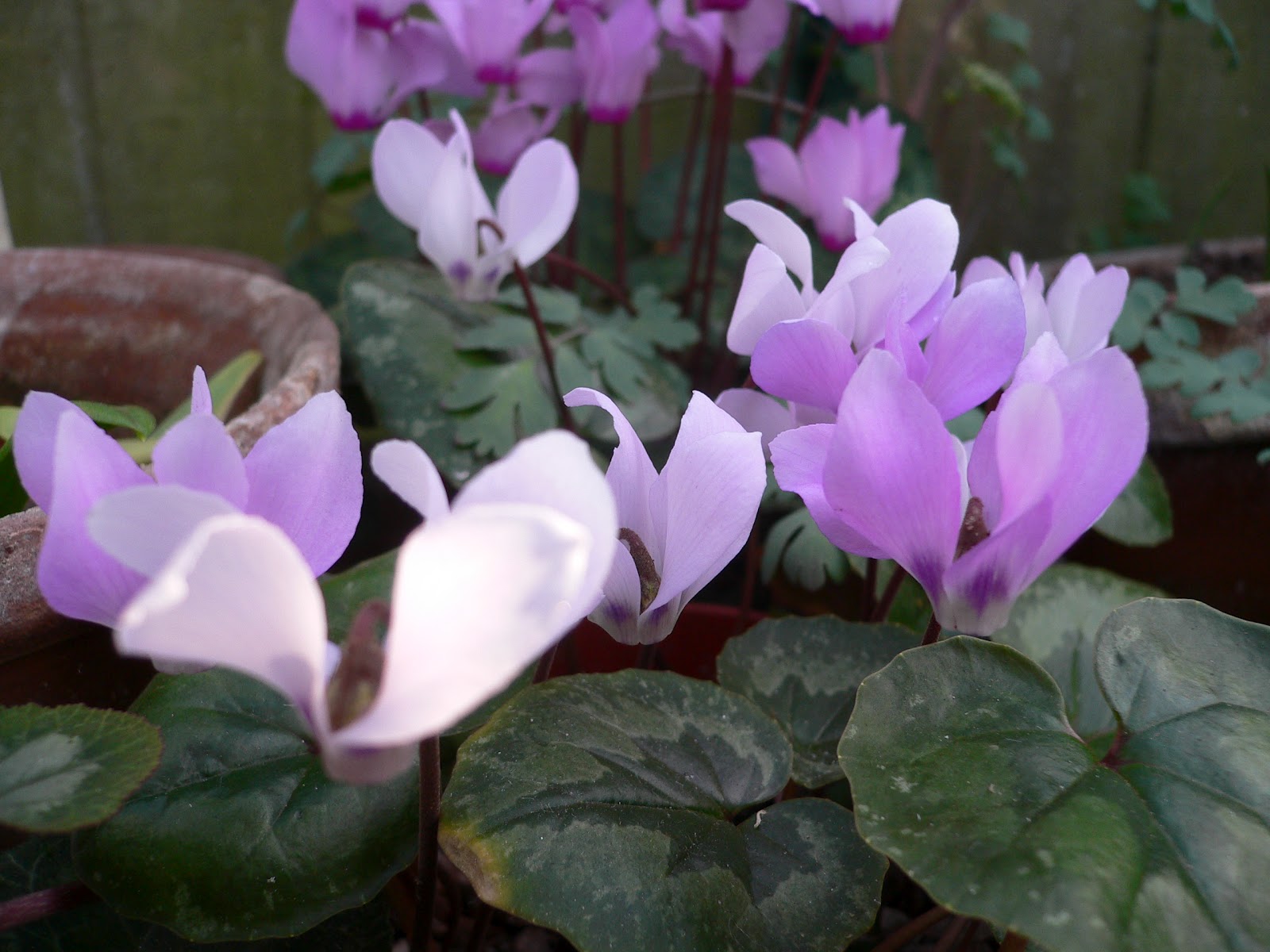
Cyclamen pseudo-ibericum pale forms
This came to me as "pseudo-ibericum white" seed from the Cyclamen Society seed exchange. I didn't expect a pure white but one in this potful does have nearly white flowers and a very dark nasal blotch which is unusual. Unfortunately the flower is a bit dumpy - unlike these "roseum".
Saturday, March 17, 2012
Primula allionii Eureka
Ken Wooster's great triumph, a pure white allionii with almost no bad traits (it sometimes produces a four petalled flower I find). A lovely thing!
Sunday, March 04, 2012
Primula allionii hybrid
Many years ago I would sometimes find seed capscules on P. allionii - I tried a few and got good germination. Most of the plants were nice - this one I think picked up something from one other hybrid I had (Lismore Jewel?). That original hybrid has gone and over the years my "allionii" has got better and better. The reason why I think this is a hybrid is because the yellow in the eye.
Sunday, January 29, 2012
Cyclamen persicum - a beautiful weed
As defined a weed is a plant that grows where you don't want it to. In that case my greenhouse is full of weeds!
Several Cyclamen species have a habit of seeding into the sand plunge, or seed pots or pots of other Cyclamen species.
Cyclamen persifum is one of them - I usually leave them out of laziness and because quite often they outlive a pot's original occupants.
Also with Cyclamen you do get some variation from the parents - this one has a lovely pure pink shading - a bit different from other plants I have.
As an added bonus many of these self sown seedlings are quite vigorous having undergone some natural selection to my greenhouse environment and routines.
Sunday, January 22, 2012
Sunday, January 15, 2012
New Year's Plants
Some pictures of flowers ushering the very early "Spring". Primula allionii Elizabeth Burrow, Narcissus romieuxii rifanus (it may or may not be, I grew it from seed), Viala reniforme (possibly better known as V. hederacea and an early Cyclamen persicum.
Saturday, December 31, 2011
Ipheion "Rolf Fielder"
Ipheion "Rolf Fielder" is a bit of a mystery. Allegedly given to someone by Rolf at an International Plant conference the species has not been as far as I am aware, identified yet. It was under I. uniflorum but it's believed to be another species.
I've had it for several years now - this is just a seedling that escaped - I must get the main plant up into the light to flower.
It's related to the onions - the leaves and bulbs smell quite strongly.
Tuesday, December 20, 2011
Cyclamen colchicum
While I took this picture in October, right now this plant doesn't look too much different. I think I first came accross a mention of this plant in an article by Otto Schartz about the Alpine House at Jena in the AGS bulletin in 1974 - I can't remember what name it was under at the time. Since then it got moved under C. purpurascens and is now back as a species in it's own right.
I have a number of plants, one I bought as a tuber and some others I grew from seed - they are virtually identical but then I think they possibly came from the same original source.
The 1974 article described the single tuber in the Alpine House as being very slow growing and self sterile, grown in complete shade. I think there may have been a comment about it also being the slowest to flower from seed.
I think I got mine to flower from seed in about 18 months which made it one of the fastest to flower - I also got it to set seed from a single plant. I find it quite likes sun (as does C. purpurascens - sometimes).
Bearing in mind it can be rash to talk about a plant based on a single specimen, or single clone or even several collections, the plants I have apart from having the characteristic horny toothed leaf margins comes over as a more succulent, chunky version of C. purpurascens - uncannily paralleling the relationship between C. mirabile and C. cilicium and to a lesser extent C. africanum and C. hederifolium.
If anything it seems in the alpine house at least easier and more consitent than C. purpurascens - it also tends to flower later and with a more concentrated display. In my plants the fragrence is like that of it's relative - but much weaker.
Sunday, November 27, 2011
Red Admiral on Buddleia x weyeriana (Yellow Buddleia)
Red Admiral butterfly photographed today on our yellow Buddleia, presumably B. x weyeriana. It came with a lable "Dark Knight" or something similar - but I bought it in flower so I knew it was yellow.
Sunday, November 20, 2011
Monday, October 03, 2011
Cyclamen africanum
Just one pic today after a long period of quiet. This is my Cyclamen africanum - one of the few Cyclamen I have that I didn't grow from seed - this one I bought from Tilebarn nursery in 1990.
Despite having it all that time today was the first time I've been able to detect a fragrance - but then it's not usually 80F in October in the UK.
Tuesday, November 16, 2010
Cyclamen hederifolium ssp crassifolium
A not very good picture of Cyclamen hederifolium ssp crassifolium a "new" subspecies that originally came to me as C. hederifolium ssp confusum (now C. confusum). From memory there has been for some time talk that the C. hederifolium of Crete and southern Greece were different and in some ways were more similar to C.africanum. It now seems those populations are split into C. hederifolium hederifolium, ssp crassifolium and C.confusum.
I got this as seed in 1991 from the Cyclamen Society labelled confusum Fotio, Peloponnese. The flowers don't look much different (I must see if they are scented) but the leaves seem a little different from the "usual" hederifolium.
Sunday, October 31, 2010
Cyclamen cyprium, Cyclamen africanum, Cyclamen intaminatum (Tale of Three Sisters)
Sometimes it seems to me that the genus Cyclamen is like a large, extraordinarily gifted family. In such family any child that is attractive and intelligent will, tragically, always be compared with it’s more extravagant siblings and found wanting. Of course, if it was born into any other family it would have praise and attention heaped upon it. As an avid reader of books on Cyclamen, articles and general bulb or alpine books, I have noted that some “children” seem to have suffered through; unfair comparisons, outright criticism, damning by faint praise or simple lack of attention.
This piece speaks out for them and tries to redress the balance. To start with my judicial researches looked at the autumnal species.
Cyclamen cyprium seems to have had mixed reviews, many general books left it out possibly because of it’s hardiness. Roy Elliott in a chapter on Alpine Houses said “…next comes Cyclamen cyprium, not the loveliest of the race, and difficult to flower – but which carries us over until…(name withheld)” Ouch! I can imagine cyprium hiding in its bedroom for weeks after that. Chris Grey-Wilson however offers some encouragement in “Cyclamen, a guide for gardeners, horticulturists and botanists” (an absolute must for all members of this society I would think) by telling us it “is a splendid plant when well grown”. But then he points out it is one of the least hardy species and that he doesn’t find it that easy to grow. Oddly on the hardiness front, when I started re growing cyclamen about ten years ago, I lost many species in an unheated greenhouse during a particularly frosty period but Cyclamen cyprium E.S form came through untouched. I find that it is one of the species that sometimes takes a year off. That is it fails to come into growth for an entire year and then reappears the next year with a sort of sleepy air as if to say “did I miss anything?” . Strangely it seems when this happens, that sometimes all of my plants of a particular species take the year off, even though they came from different sources, are of differing ages and in different locations in the greenhouse. Last year was cyprium’s turn, but this year they are all back. I do find that it does not flower quite as freely as I would like but even so they seem to make quite a good show, with unmistakable white flowers (sometimes a pale pink) and a series of magenta markings at the auricles. It is very sweetly scented and I find it has a pleasing habit, some flowers open before the leaves but at it’s peak it usually presents itself well, with a mound of leaves and a central bunching of flowers. As to the leaves these vary, a single sowing gave me plants with plain olive leaves bar two lighter spots at the leaf apex to one with leaves a mixture mainly a sage green with darker markings. There is also E.S form, which stands for Elizabeth Strangman, which has leaves spotted and splashed with white, which is quite fun.
Cyclamen africanum has an unhappy fate, sometimes unaccountably it is the only plant not illustrated in a book or sometimes it is just plain ignored. Something a bit like an old style communist leader that gets quietly erased when they fall out of favour. Paranoia aside it seems to get much less column inches than perhaps it deserves. It gets more of a write up in reports of the Cyclamen Society’s shows though. I think part of the problem is that it seems so close to hederifolium, but hederifolium is so much more versatile and generally more flamboyant. Africanum’s twin is hardy, more variable and comes in several named forms (I have plants of Cyclamen africanum album, but wonder what they will turn out to be). The other problem is that there is confusion over what is and what isn’t africanum with allegations that many of the plants in cultivation are in fact hybrids with hederifolium. My own plant of “africanum” does appear as a slightly bigger version of hederifolium but the petals are a little floppy, which detracts from its appearance. I do however have seedlings of the “genuine” plant from original seed collections in Algeria. One flowered this year and paradoxically appeared as a smaller, stiffer version of hederifolium. Very prim and proper with very broad mid green glossy leaves with four medium pink flowers, of a uniform size and height, it has considerable appeal. Most of my other plants from this sowing have similar leaves, while plants from JCA855 are equally distinct with greyish green arrow leaves, satisfactorily succulent with a horny tooth edge. A recent visit to Wisley revealed plants with mainly pale pink blooms on tall stems with one plant approximating to the miniature that I had flowered this year. Among the plants in the “For sale” frames I found a plant with a single deep rose pink flower unaccompanied by leaf (too late, it’s gone now!)
An objective description of the “typical” Cyclamen intaminatum would hardly thrill. It would read something like, “small, dark plain leaves, with unscented, small off white flowers with grey veining”. Even so as it matures you can end up with a dainty potful and a sowing from a single seedpod, planted in a shady trough has allowed it to show off a certain pixie charm outside. I have a few plants with patterned leaves but these seem much weaker which is a shame, just giving a few leaves and flowers after several years. Losses of this form seem to be quite high while the plain leaved form seems reasonably tough. I do have one unusual plant which I think appeared in the plunge material of my greenhouse. It seems to be a pale pink intaminatum, pale pink petals shading to a white nose with grey veining and patterned leaves rather large for intaminatum. It’s vigour, coupled with it’s appearance in the plunge material when I don’t think any of the patterned intaminatums had set seed makes me wonder if it is a hybrid. It could be a cross between the two forms of intaminatum, or intaminatum x cilicium or intaminatum x mirabile. I was shown an almost identical plant by a local plantswoman so I wonder if other members have similar plants?
I hope this has done a little to even the scales of horticultural fairness and that now my own plants of C.africanum, cyprium and intaminatum will show their gratitude by increasing and flowering with an as yet unheard of exuberance.
Mark Griffiths, November 1999 (Originally published in the Alpine Garden Society journal)
Friday, October 15, 2010
Phalaenopsis Culture
In this post I'll attempt to tell you how I grow and flower Phaleanopsis in the home.
First a bit of background to explain why the treatment of these plants is somewhat different from “normal” house plants.
In nature phaleanopsis are generally epiphytes, hanging upside down with roots like sphagetti over the surface of branches, in moss or leaf litter. The plants have adapted to having a compost with a lot more air in it than normal ground plants, with a very low level of mineral salts.
In cultivation Phaleanopsis require a very open compost, either based on bark, but it can be stones or even foam chunks. The main function of the compost is to give the plant something to hang onto.
Phaleanopsis need fresh air in the compost. The way you achieve that is by pouring water through the compost, this forces stale air out – and as the water drains out it sucks new air in. So you can pour a pint or two through when you water them. If you pour the water in like that, it should pour out almost immediately come back out again. Don’t allow plants to stand in water.
The pot must have drainage holes, and the compost very free draining, if you use normal plant pots you might want to add extra holes in the side of the pot.
Because tap water will tend to have salts, chlorine etc it is better to use rainwater if you can. If you have to use tap water, filtered and then allowed to stand for 24hrs (to lose the chlorine). The water should be tepid, not cold.
Water once a week.
Use orchid feed, if you can get the flower fertilizer and growth fertilizer all the better. I feed for 3 weeks in the month and give them a week off – this is used to flush out any salts building up from the fertilizer.
Phaleanopsis like a bright position, but no direct sun. Some will be ok in quite dark situations but they may not flower as much.
Make sure they are not in drafts, avoid places where it gets cold at night – so although a north facing window might be ideal, bear in mind close to windows can get cold (especially if you close curtains).
Avoid fruit . Yes really, it causes the flower buds to drop, because of the ethylene. Gas Fires are not good either. Putting them over a radiator is likely to dry them out.
They like warm and fairly humid. Planters with damp stones can help with the humidity – but don’t let them stand in water. Don’t get water on the leaves (especially in the centre) – if you due use a kitchen towel to just suck up the drops.
If it stops flowering but the stalk remains green, I leave it. If it goes brown at the end just cut it back to the little leaf/bud on the stem. The reason is they often then flower again from old stalks.
Pictures from the top: Phal Cordova, Phal mariae, Phal Brother Princess.
Sunday, May 30, 2010
Trough a year on.
Last year after several years with various "normal alpines" that either failed because it was too shady or eaten by slugs (it's real stone and attached to a stone wall so it can't be re-sited) I replanted the trough with various gesneriads.
Oddly the Haberleas did not flower, one is looking poorly and the Ramonda myconi has yet to do anything but the R. nathaliae were magnificent!
Sunday, March 14, 2010
Iris Katherine Hodgkin & Primula allionii Malcolm
Iris Katherine Hodgkin, some people love it, others hate it. I like it. I bought it in bud and will try it outside. I inherited a number of reticulate irises when I came to this garden and they seem to do very well, so hopefully this will follow suit.
The second flower is Primula allionii "Malcolm" which I've had for years now.
Saturday, January 30, 2010
Sunday, January 10, 2010
Winter Freeze
Well blogger seems to now have a mind of it's own about where it places text and images, no doubt as a result of some "improvement to the system". I have been intending to start putting up pictures every week but the cold weather here has meant that everything has gone into a state of suspended animation and for the last week we have had snow which is pretty but not particularly illuminationg (" the plants are under there somewhere") so I'm posting some pictures from the week before where we had a cold snap so that you can see the build up of ice crystals on fennel, then on the spent anemone japonica stalks and finally I think on a euphorbia.
Enjoy and keep warm!
Enjoy and keep warm!Sunday, December 13, 2009
Looking a little closer
One thing about winter is that it is a simpler time in the garden and the moments between the rain when I go out, I can really appreciate the little things. Top left, a Euphorbia after the rain, right the lime green flower buds of Helleborus feotidus, moss on the apple tree and finally a pink pulmonaria.
Tuesday, December 08, 2009
Solanum laxum alba
My late flowering Solanum laxum alba, a potato vine. Not too many flowers this year, it's in too shady a spot I think and I've not been pruning it. I'll try and remember next year.
Subscribe to:
Posts (Atom)


